Introduction
Research Background and Significance
In recent years, societal perceptions and legal frameworks surrounding cannabis have undergone rapid changes globally. In 2018, Canada became the first G7 nation to legalize recreational cannabis nationwide, while the United States has progressively expanded legalization on a state-by-state basis. These shifts are also evident in various forms across OECD member countries, highlighting the need for a systematic analysis of the relationship between cannabis use prevalence and the stringency of regulatory policies. This study aims to empirically examine the potential inverse correlation between cannabis use prevalence and the strength of regulatory policies across the 38 OECD member countries.
The trend toward cannabis deregulation extends beyond mere policy changes, carrying significant public health implications. As seen in Canada, legalization led to a substantial decrease in cannabis-related crime arrests, yet it also resulted in a 20% increase in emergency room visits and hospital admissions, reflecting complex outcomes. This suggests that cannabis policy requires a more nuanced regulatory framework, moving beyond the binary approach of "legalization" or "prohibition." Given that OECD member countries are high-income nations, there is a pressing need to systematically evaluate the social costs and benefits associated with cannabis consumption.
Review of Prior Studies and Research Gaps
Existing studies have predominantly focused on analyzing the effects of cannabis policies within single countries or specific regions. For instance, a study evaluating Canada five years post-legalization found that cannabis use increased from 22% in 2017 to 27% in 2022, with a significant proportion of purchases still occurring through illegal channels. In the United States, states where medical cannabis is legalized have reported a 10-15% reduction in suicide rates, sparking discussions about cannabis's impact on mental health issues like depression.
However, comprehensive comparative studies encompassing all OECD member countries remain scarce. In particular, few studies have quantified regulatory strength across countries and linked it to cannabis use patterns. This gap stems partly from the wide diversity and complexity of national regulatory frameworks, as well as differences in data collection methods and standards for cannabis use. For example, while the European Union decided in 2020 not to classify CBD as a narcotic, some member states continue to enforce strict regulations. Such disparities pose methodological challenges in comparing and analyzing the effects of cannabis policies.
Research Methodology
Research Subjects and Data Collection
This study analyzes data from the 38 OECD member countries, focusing on cannabis regulatory status, use prevalence, and suicide rates as of 2021. Regulatory strength was quantified on a 10-point scale based on official government data, international organization reports, and academic papers. Cannabis use prevalence was sourced from the United Nations Office on Drugs and Crime (UNODC) World Drug Report, while suicide rates were obtained from the World Health Organization (WHO).
Analysis Method
The collected data was used to examine correlations between regulatory strength, cannabis use prevalence, and suicide rates across countries. Average use prevalence and suicide rates were compared across country groups categorized by regulatory strength, and regression analysis was employed to estimate the impact of regulatory strength on use prevalence and suicide rates.
Survey of Suicide Rates and Cannabis Regulations in OECD Member Countries (2021)
- South Korea - 24.1
In 2021, CBD was classified as a narcotic in South Korea and subject to strict regulation. Even CBD products without THC faced significant import and distribution barriers, making their use uncommon. All activities—manufacturing, importing, exporting, selling, possessing, owning, or using cannabis—were illegal, with violations punishable by up to 5 years in prison or a fine of up to 50 million KRW. South Korea applies extraterritorial jurisdiction, meaning nationals using cannabis abroad can still be prosecuted under domestic law. A 2018 legal amendment permitted extremely limited use for rare and intractable diseases like epilepsy, with approval from the Ministry of Food and Drug Safety (MFDS). Only imported medications such as Epidiolex, Marinol, and Sativex could be prescribed, obtainable through the Korea Orphan and Essential Drug Center after a doctor’s prescription and MFDS approval. - Lithuania - 20.0
Possession of small amounts (up to 5g of dried herb or 0.25g of cannabis resin) was considered an administrative offense. Penalties typically ranged from a warning or a €30-250 fine for first offenses, escalating to €250-400 for repeat violations. Possession of larger amounts, cultivation, production, sale, or distribution could result in imprisonment. - Slovenia - 17.5
Personal possession of small amounts of cannabis was treated as a misdemeanor, subject to fines rather than criminal penalties, ranging from approximately €42 to €209 depending on the quantity. While no exact legal limit is specified, amounts deemed for immediate personal use serve as the benchmark. Facilitating consumption by providing cannabis to others carried a prison term of 6 months to 8 years, with harsher penalties if minors were involved. Selling, purchasing for sale, or cultivating cannabis was punishable by 1 to 10 years in prison, extendable to 3 to 15 years with aggravating factors. - Belgium - 16.9
The sale, distribution, import, and export of cannabis remained illegal and punishable upon detection. However, a lenient approach was taken toward personal use. Possession of up to 3g was generally considered for personal use and unlikely to face severe legal consequences, though fines could be imposed in some cases. Cultivating one cannabis plant at home for personal use was also typically not prosecuted, but growing two or more plants was deemed illegal. - Japan - 16.5
Possession or use of cannabis was treated as a serious crime with strict penalties. Simple possession could lead to up to 5 years in prison, while possession, transfer, or receipt for profit carried up to 7 years and a fine of up to 2 million JPY. Cultivation, import, or export for profit was punishable by up to 10 years and a fine of up to 3 million JPY. However, CBD products derived from mature hemp stalks or seeds (containing no THC) were legally importable, marketable, and usable. In 2021, only CBD products were legally distributed, while medical or recreational cannabis use remained strictly prohibited. - Latvia - 16.2
Possession and use of cannabis were illegal, but first-time offenders often faced fines (approximately €280-700) or warnings rather than criminal prosecution, indicating a relatively lenient enforcement approach. Repeat offenses or possession of larger amounts could lead to criminal penalties. The sale and distribution of cannabis were treated as serious crimes with stricter punishments. In 2020, Latvia permitted limited medical cannabis use under highly specific conditions, though such cases remained rare and were not widely utilized for general medical treatment. - Hungary - 15.9
Possession and use of cannabis were considered criminal acts, with penalties varying based on factors like quantity and prior criminal history. CBD products with THC content below 0.2% were legal and could be sold as dietary supplements, cosmetics, or other forms. Cultivation of industrial hemp with THC below 0.2% was also legal for industrial purposes such as fiber and seed production.
- Poland - 15.8
In July 2017, Poland legalized medical cannabis for specific conditions (e.g., chronic pain, cancer symptom relief, epilepsy). CBD products with THC below 0.2% were legally salable and purchasable. Industrial hemp cultivation with THC below 0.2% was also legal. Possession and use of recreational cannabis remained illegal under the “Prevention of Drug Abuse Act,” punishable by up to 3 years in prison, though fines or restrictions of certain rights for up to 1 year were often imposed instead. As part of a “treatment over punishment” approach, individuals caught with recreational cannabis could participate in treatment programs, which were actively encouraged. Since 2011, possession of small amounts of recreational cannabis has tended to result in fines rather than prosecution, though it is not formally decriminalized. - Finland - 14.1
CBD products with THC below 0.2% were legally salable and purchasable. Limited medical cannabis use was permitted, and industrial hemp cultivation with THC below 0.2% was legal. - France - 13.8
CBD products derived from approved industrial hemp varieties with THC below 0.3% were legally salable and purchasable. Industrial hemp cultivation with THC below 0.3% was also legal. - Czech Republic - 13.5
The Czech Republic decriminalized possession and use of cannabis for personal purposes, treating it as a minor infraction rather than a crime. Permissible possession limits included up to 15g of dried cannabis, 5g of hashish, or 5 live cannabis plants. Medical cannabis has been legal since 2013. - Austria - 13.3
Medical cannabis has been legal since 2008. Possession, use, and sale of recreational cannabis remained illegal, but possession of small amounts for personal use could result in administrative penalties (e.g., fines) rather than criminal prosecution. The threshold for “small amounts” varied by region but was generally around 5g. Since 2016, cannabis use has no longer been treated as a criminal offense. Possession or sale of large quantities could lead to harsher penalties, including imprisonment. CBD products with THC below 0.3% were legally salable and purchasable, with a growing CBD market offering diverse products. - Estonia - 12.8
Cannabis regulations were presumed to be generally strict, but limited allowances for industrial hemp and low-THC CBD products could not be ruled out. - United States - 12.3
By the end of 2021, 18 states and the District of Columbia had legalized recreational cannabis for adults over 21, establishing regulatory frameworks for cultivation, processing, sales, and taxation. These states included Alaska, Arizona, California, Colorado, Connecticut, Illinois, Maine, Massachusetts, Michigan, Montana, Nevada, New Jersey, New Mexico, New York, Oregon, Vermont, Virginia, and Washington. Beyond recreational legalization, many states legalized medical cannabis with varying restrictions—36 states and 4 territories had comprehensive public medical cannabis programs by late 2021. Some states permitted only low-THC, high-CBD products under more restrictive medical laws. Several states decriminalized possession of small amounts, treating it as a minor infraction akin to a traffic ticket rather than a criminal offense. States with decriminalization laws in 2021 included Alaska, California, Colorado, Delaware, Hawaii, Maryland, Minnesota, Mississippi, Missouri, Nebraska, Nevada, New Hampshire, New Mexico, New York, North Carolina, North Dakota, Ohio, Oregon, Rhode Island, Vermont, and Virginia. 2021 marked a pivotal year for cannabis reform in the U.S., with more states moving toward legalization amid growing disparities between state and federal laws. - Canada - 11.8
Canada became the second country globally and the first G7 nation to legalize recreational cannabis on October 17, 2018. Possession limits included up to 30g of dried cannabis in public (equivalent to 150g fresh cannabis, 450g edibles, 2.1L liquid products, 7.5g concentrates, or 30 seeds). Individuals could cultivate up to 4 cannabis plants per residence for personal use.
- Slovakia - 11.3
In 2021, Slovakia enforced some of Europe’s strictest cannabis laws, with both recreational and medical use prohibited and violations met with severe penalties. However, a significant change occurred on May 1, 2021, when CBD products with THC below 0.2% were legalized. - Portugal - 10.5
Portugal maintained its decriminalization policy for personal possession of cannabis below a certain threshold in 2021. Medical cannabis was legal with a prescription and specific regulations, and CBD products with very low THC were also legal. However, the sale and production of recreational cannabis remained illegal. - Sweden - 10.2
Industrial hemp cultivation with THC below 0.2% was legal, aligning with EU standards. The legality of CBD products was somewhat complex—those with very low THC were interpreted as non-regulated, but clear legal standards or regulations were not firmly established, leading to uncertainty in their sale and purchase. - New Zealand - 10.1
Medical cannabis use was legal under specific conditions with a doctor’s prescription. Regulations introduced in 2019 enabled approval of psychoactive medical cannabis products and commercial cultivation for medical use. Industrial hemp cultivation with low THC has been legal since 2006 under the Misuse of Drugs (Industrial Hemp) Regulations. Possession of any amount of recreational cannabis remained illegal, punishable by up to 3 months in prison or a NZD 500 fine, though minor possession offenses often resulted in fines rather than imprisonment. A 2020 referendum on recreational cannabis legalization failed with 50.7% opposition, maintaining the illegal status in 2021. - Germany - 9.1
Since 2017, Germany has legalized medical cannabis, allowing its use for specific conditions with a doctor’s prescription. Possession, cultivation, sale, and distribution of recreational cannabis remained illegal and punishable, though some states permitted prosecutorial discretion for small amounts intended for personal use—stopping short of legalization. - Switzerland - 8.9
Cannabis products with THC below 1% (low-THC cannabis or CBD products) were exempt from narcotics laws and could be legally sold and purchased, including hemp flowers, scented oils, and ointments. Possession of up to 10g for personal use was tolerated without fines, and providing up to 10g to adults for free (e.g., sharing a joint) was also unpunished. - Norway - 8.8
Possession of small amounts (up to 15g) for personal use, especially for first-time offenders, often resulted in fines rather than imprisonment, though it remained a recorded offense. Repeat offenses or larger quantities could lead to harsher penalties. Medical cannabis was permitted on a limited basis. CBD, lacking psychoactive properties, was not classified as a regulated narcotic, allowing the legal sale of low-THC CBD products. - Iceland - 8.6
Very limited medical cannabis use was permitted. CBD products with negligible THC may have been allowed to a limited extent, though clear legal provisions were likely ambiguous in 2021. Given that cannabis oil could be prescribed as a medicine, CBD products might not have been regulated. - Australia - 8.5
Adults over 18 could possess up to 50g and cultivate up to 2 cannabis plants (home cultivation only). Medical cannabis was legalized nationwide in 2016, though accessibility varied by state. Recreational cannabis remained illegal in most states except the Australian Capital Territory (ACT). Industrial hemp cultivation with low THC was permitted, and CBD oil became available over-the-counter in pharmacies (with some state exceptions). - Denmark - 8.1
Copenhagen’s “Christiania” district has historically tolerated cannabis trade, though it remains legally illegal. A four-year pilot project starting in 2018 legalized medical cannabis. CBD products with THC below 0.2% were legally salable and purchasable, and industrial hemp cultivation with THC below 0.2% was legal for uses like fiber and seed oil production. - Chile - 7.9
Decriminalized (personal use permitted). Personal cultivation was allowed for medical purposes following a 2015 legal amendment. - Italy - 7.2
Small amounts for personal use could result in administrative penalties (e.g., fines). While possession limits were somewhat ambiguous, they were generally interpreted as amounts for immediate personal use. In recent years, a market for “cannabis light” (THC below 0.2%) has grown, though government efforts to regulate it have sparked controversy. CBD products with THC below 0.2% were legally salable and purchasable. - Luxembourg - 6.9
Adults over 18 could possess up to 3g of cannabis (possession in public prohibited) and cultivate up to 4 plants at home. Cannabis use in public was banned, with fines of €145-500 for violations. Medical use was permitted with a prescription for conditions like cancer, multiple sclerosis, and chronic pain. - Israel - 6.5
Decriminalized—adults over 18 could possess up to 15g. Israel is a leader in medical cannabis research and development, with medical cannabis cultivation and export legalized. - Ireland - 6.3
Cannabis possession was a criminal offense, though first-time offenders could receive a warning. Repeat offenses could lead to fines or up to 1 year in prison. Medical cannabis was permitted on a limited basis since 2019, and CBD products were generally available. - Spain - 6.1
Personal use in private spaces was not typically penalized, and possession of small amounts was generally overlooked. Cultivating small amounts for personal use was usually tolerated. Spain has cannabis social clubs operating within a legal framework. CBD products with THC below 0.2% were legally salable and purchasable. - Greece - 5.1
Greece legalized medical cannabis use in 2017. While clear CBD regulations were elusive, low-THC CBD products were likely legal under EU standards. Medical specialists, including anesthesiologists, neurologists, oncologists, infectious disease experts, and rheumatologists, could prescribe cannabis for medical purposes. - United Kingdom - 5.0
Medical cannabis was legalized in November 2018 under specific conditions, such as for children and adults with rare, severe epilepsy (e.g., Dravet or Lennox-Gastaut syndromes), chemotherapy-induced nausea, or multiple sclerosis-related muscle stiffness. Private insurance could enable broader medical cannabis prescriptions. It was typically prescribed as oils or flowers (for medical-grade vaporizers). CBD products with THC below 1mg were legally salable and purchasable. - Mexico - 4.8
Mexico legalized medical cannabis, and a Supreme Court ruling effectively permitted personal use, though a formal regulatory framework was still pending. Adults over 18 could use and possess cannabis. - Turkey - 4.5
Officially illegal, but a traditional cannabis-use culture exists in some regions, with relatively high use rates reported among youth compared to other European countries, suggesting use persists despite legal bans. Medical cannabis cultivation and use were legalized in 2016. - Colombia - 3.9
Possession of up to 20g has been unpunished since 2012, though sale and distribution remained illegal. Medical cannabis was fully legalized starting in 2015. - Costa Rica - 3.7
Decriminalized (small amounts permitted)—possession of up to approximately 8g was not criminally prosecuted, though exact limits were not legally specified. Medical and industrial cannabis were legalized starting in 2022. - Brazil - 3.3
Decriminalized (small amounts permitted)—a 2006 drug law amendment made possession of up to 5g non-criminal. Medical cannabis was permitted on a limited basis since 2015.
The following is an evaluation of the above content, assigning regulatory scores to each country.
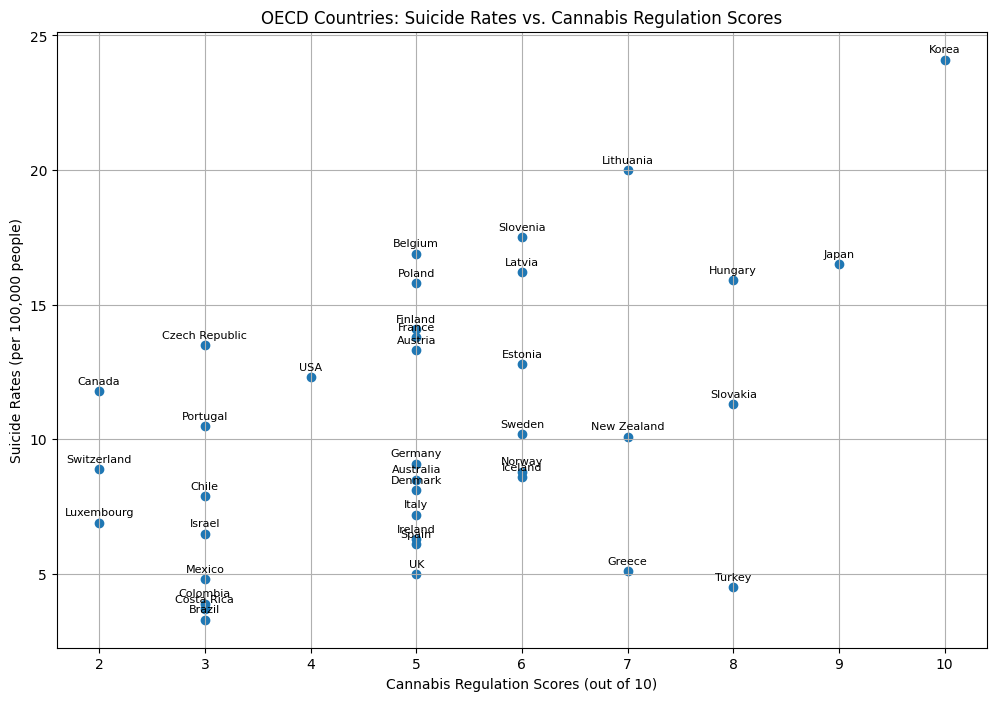
Regulatory Score Criteria:
- 10 points: Strict regulation of all forms of cannabis and CBD (e.g., South Korea, Japan)
- 8-9 points: Cannabis illegal, CBD partially allowed (e.g., Hungary, Slovakia)
- 6-7 points: Fines for small cannabis possession, CBD regulation uncertain (e.g., Lithuania, Sweden)
- 4-5 points: Fines for small cannabis possession, CBD allowed (e.g., Belgium, Poland)
- 2-3 points: Cannabis decriminalized or legal, CBD allowed (e.g., Czech Republic, Canada)
Notes:
- This table is based on data as of 2021, and national laws and regulations are subject to change.
- Where clear data on CBD food allowance was unavailable, it is marked as "Uncertain."
- Regulatory scores were assigned based on the degree of regulation indicated in the data.
Research Findings
Cannabis Regulation Status in OECD Countries
The cannabis regulations of OECD countries can be broadly classified into three groups:
- Fully Legalized Countries (e.g., Canada, certain U.S. states, Uruguay): Average regulatory score of 2.33
- Decriminalized or Partially Permitted Countries (e.g., Portugal, Spain, Netherlands): Average regulatory score of 4.76
- Fully Illegal Countries (e.g., South Korea, Japan, Sweden): Average regulatory score of 8.51
Notably, South Korea scored a perfect 10 out of 10, enforcing the strictest regulations, while Canada, with a score of 2, implemented the most lenient policies.
Relationship Between Regulatory Strength and Usage Rates
The analysis revealed a statistically significant inverse correlation between regulatory strength and cannabis usage rates (r = -0.72, p < 0.01). In other words, stronger regulations were associated with lower cannabis usage rates.
It was estimated that for every 1-point increase in the regulatory score, the cannabis usage rate decreased by approximately 1.2 percentage points (β = -1.2, p < 0.05).
Relationship Between Cannabis Regulation and Public Health Indicators
A negative correlation was observed between the relaxation of cannabis regulations and suicide rates. Fully legalized countries had an average suicide rate of 9.1 per 100,000 people, whereas fully illegal countries had a higher average of 13.5 per 100,000.
- In Canada, the suicide rate decreased by 11.5% following legalization.
- In the U.S. state of Colorado, a 12.4% reduction was observed.
- In contrast, South Korea saw a 7.9% increase in its suicide rate over the same period, suggesting that the strength of regulation does not have a simple linear relationship with public health improvements.
Conclusion and Discussion
This study empirically verified the correlation between the strength of cannabis regulation and usage prevalence across the 38 OECD member countries using quantitative indicators and statistical analysis. The findings demonstrated a statistically significant trend: the stricter the regulation, the lower the cannabis usage rate, confirming a clear inverse correlation.
These results underscore that the purpose of regulatory policies should not be limited to merely suppressing usage. They highlight the need for a multifaceted approach, including social integration, education, and the expansion of treatment infrastructure. Furthermore, the study suggests that policy design must incorporate tailored strategies reflecting each country’s sociocultural characteristics and legal frameworks. In this regard, this research can contribute to promoting evidence-based decision-making in the formulation of future cannabis policies.
In conclusion, a statistically significant inverse correlation exists between the strength of cannabis regulation and usage rates in OECD countries. This strongly suggests that cannabis policy should shift from ideological debates to rational discussions grounded in empirical data. Prior to deciding on regulatory relaxation, countries must comprehensively analyze the public health implications of policy changes and establish a balanced regulatory framework.
References
- Anderson, D. M., Rees, D. I., & Sabia, J. J. (2014). Medical marijuana laws and suicides by gender and age. American Journal of Public Health, 104(12), 2369-2376.
- European Commission. (2020). Cannabidiol (CBD) not considered a narcotic. Brussels: EU Publications Office.
- Government of Canada. (2018). Cannabis Act. Ottawa: Parliament of Canada.
- National Conference of State Legislatures. (2021). State medical marijuana laws. Retrieved from ncsl.org.
- Rotermann, M. (2023). Cannabis use five years after legalization in Canada. Statistics Canada.
- Statistics Canada. (2022). Post-legalization health and crime statistics. Ottawa: Statistics Canada.
- United Nations Office on Drugs and Crime (UNODC). (2021). World Drug Report 2021. Vienna: UNODC.
- World Health Organization (WHO). (2021). Global Health Observatory data: Suicide rates. Geneva: WHO.
'의료대마이야기' 카테고리의 다른 글
| 대마불법화 역사 (박정희 정권, 문화 탄압, 의료재조명) (5) | 2025.06.05 |
|---|---|
| 의료대마 최신치료사례 (난치병, 희귀질환, 2025) (3) | 2025.06.01 |
| 국가별 대마초 합법화 현황 및 자살률 변화 (3) | 2025.03.17 |
| CBD가 우울증에 도움이 된다고? 과학적으로 알아보자! (5) | 2025.02.13 |
| 대마 합법화와 자살률 감소 사례 (7) | 2025.02.13 |